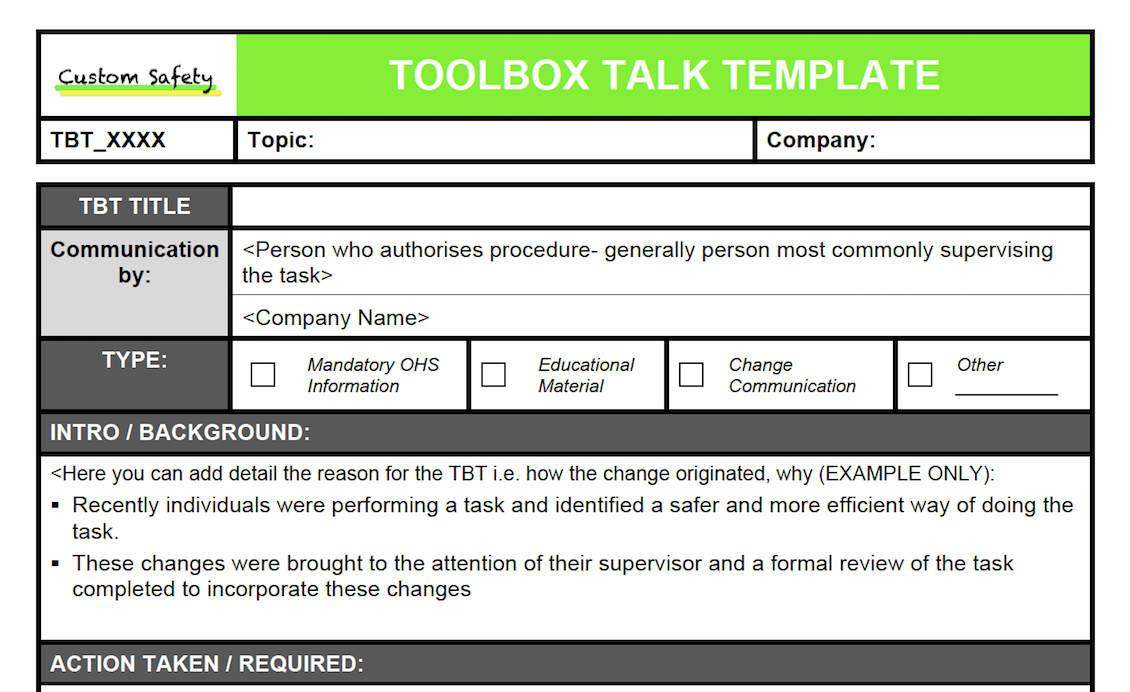
Most tool box talks fail before they begin—not because the content is bad, but because they’re long, generic, and forgotten by lunch. Short tool box talks cut through the noise. They’re designed to be under 10 minutes, hyper-focused, and directly relevant to the crew’s daily work. When done right, they don’t just check a compliance box—they change behavior.
Forget PowerPoint slides summarizing OSHA regulations. The best short tool box talks revolve around one clear risk, one actionable takeaway, and real conversations. This is how teams stay alert, avoid complacency, and prevent incidents.
Let’s break down how to make them stick—without wasting time.
Why Short Tool Box Talks Outperform Long Safety Meetings
Traditional safety meetings often last 30 minutes or more. In reality, attention drops after five. Short tool box talks align with how people actually learn and retain safety information: in small, frequent bursts.
Key advantages:
- Higher retention: Focused messaging improves recall
- Better engagement: Workers contribute more in brief, informal settings
- Easier scheduling: Can be held at shift start, during equipment setup, or post-inspection
- Real-time relevance: Address current conditions—wet floors, high winds, new equipment
A roofing crew in Alberta reduced near misses by 40% in three months after switching from weekly 25-minute safety lectures to daily 7-minute tool box talks on fall protection checks. The key difference? Each talk ended with a quick “show me” drill—where each worker demonstrated how they’d secure their harness before stepping onto the roof.
Long meetings inform. Short talks activate.
Structure of an Effective Short Tool Box Talk
A well-structured short tool box talk follows a simple but powerful format. Stick to this template and avoid drifting into lecture mode.
1. Hook (30 seconds) Start with a real incident, near miss, or hazard seen that morning. Example: “I saw a frayed extension cord near the mixer this morning. Could’ve been someone’s foot or worse.”
2. Focus (2–3 minutes) Define the hazard and why it matters today. Avoid broad definitions—get specific. Example: “A damaged cord increases shock risk—especially in wet conditions. We’re pouring today, so water is unavoidable.”
3. Action Step (1–2 minutes) Give one clear behavior to adopt or avoid. Example: “Before plugging in, do a 10-second visual check: cuts, exposed wires, cracked plug.”
4. Group Input (2 minutes) Ask: “Have you seen this before?” or “What would you do differently?” This turns passive listeners into active participants.
5. Close with Accountability (30 seconds) End with a commitment: “Today, we all check our cords. If it looks wrong, tag it and report it.”
This structure ensures clarity, brevity, and buy-in—all within 8 minutes.

Real-World Examples of High-Impact Short Talks
Generic talks about “staying safe” don’t work. The best ones are situation-specific and actionable.
Example 1: “Hand Protection on Rough Surfaces”
- Hook: “Saw someone removing gloves to handle rebar—skin contact with rusted steel raises tetanus risk.”
- Focus: “Cut, abrasion, and infection risks when handling raw materials.”
- Action: “Wear cut-resistant gloves—even for 30-second tasks.”
- Input: “What type of gloves do you prefer for rebar work?”
- Close: “No bare hands on metal—today and every day.”
Example 2: “Ladder Stability on Uneven Ground”
- Hook: “Almost watched a guy tip over adjusting conduit on a wobbly ladder.”
- Focus: “Most ladder falls happen due to improper setup, not height.”
- Action: “Check ground level, use a spotter if needed, or use a stand.”
- Input: “When was the last time you used a ladder on soft soil?”
- Close: “If the base isn’t solid, don’t climb.”
Example 3: “Eye Protection During Grout Mixing”
- Hook: “Grout dust caused eye irritation in two workers last week.”
- Focus: “Fine particles become airborne and linger.”
- Action: “Wear safety goggles—safety glasses aren’t enough.”
- Input: “Who’s used a face shield for mixing?”
- Close: “Goggles on before the first scoop.”
These aren’t policy recaps—they’re behavior nudges based on real risk.
Common Mistakes That Kill Engagement
Even short tool box talks can fail. Here’s what to avoid:
1. Repeating the same topic monthly without context Hearing “PPE matters” every month breeds indifference. Instead, anchor it: “Last week, PPE prevented a chemical splash from reaching the eyes on Floor 3.”
2. One-way delivery If the supervisor does all the talking, it’s a lecture, not a talk. Silence = disengagement.
3. Lack of follow-up Did anything change after the talk? Spot-check compliance later: “I’ll be watching for glove use during rebar handling.”
4. Unrealistic expectations Telling workers to “always” do something ignores real pressures. Better: “If you’re rushing, pause and do the 10-second check. It’s faster than an incident report.”
5. Ignoring feedback If workers suggest a better way to handle a task, acknowledge it. “Good point about the magnetic tray for screws—let’s try it tomorrow.”
Avoid these, and your short talks stay credible and practical.
Integrating Short Tool Box Talks Into Daily Workflow For maximum impact, tool box talks should feel like part of the job—not an add-on.
Best Times to Hold Them:
- Pre-shift: During gear checks
- Post-equipment inspection: After reviewing machinery
- Before high-risk tasks: Before lifting, cutting, or working at height
- After a near miss: While the memory is fresh
Pro Workflow Tips:
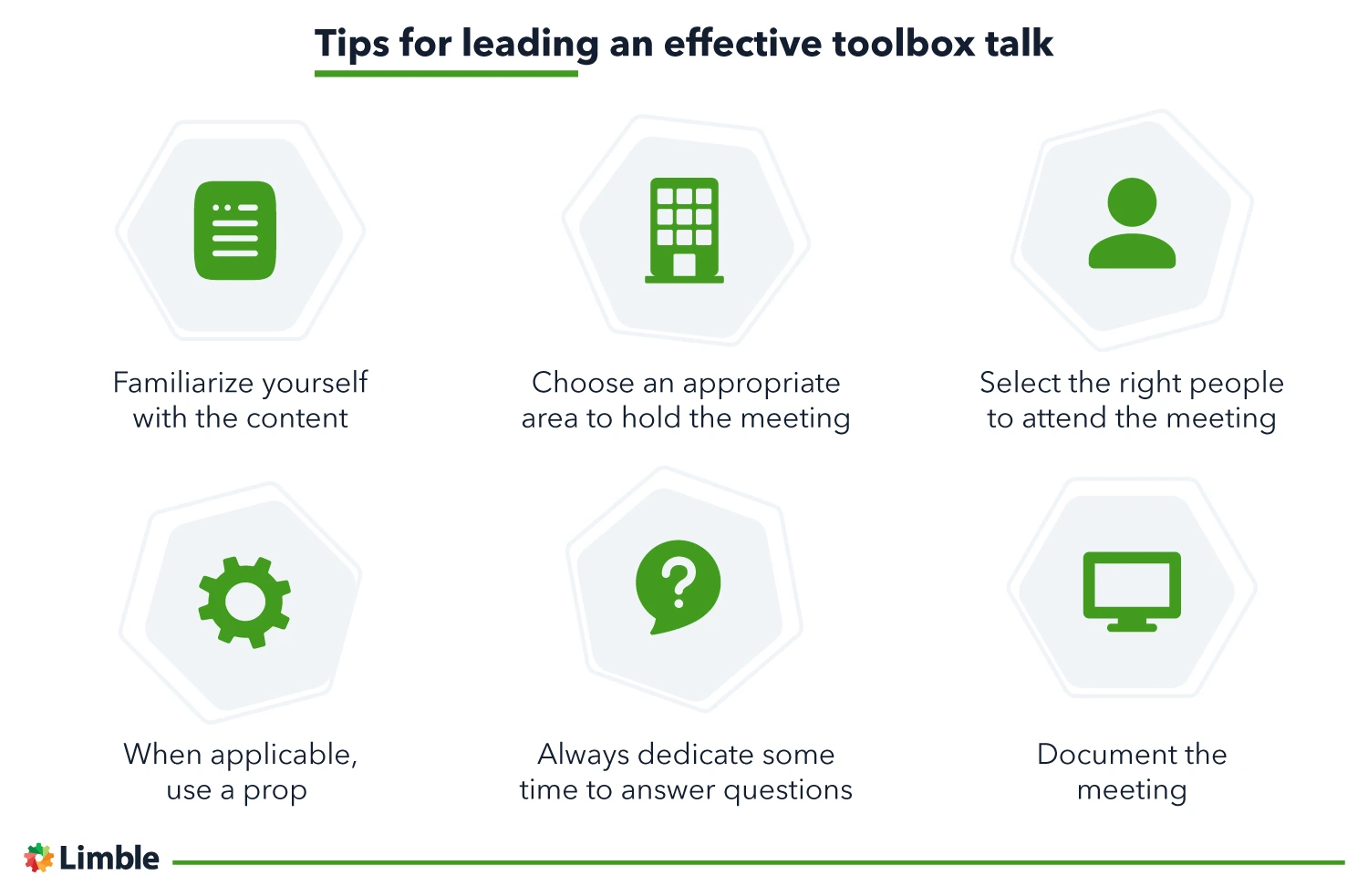
- Use visual aids: Hold up a damaged glove or cord as a prop.
- Rotate facilitators: Let experienced crew members lead occasionally—fresh voices keep attention.
- Log briefly: One sentence in a logbook: “Talked ladder stability—spotter used on Lift 2.”
- Link to permits: Reference the talk in JSA or work permit documentation.
A civil crew in Texas holds their short talk while waiting for concrete trucks. It’s not scheduled downtime—it’s used downtime. Result? 100% attendance, every time.
Five Practical Topics for Your Next Short Tool Box Talk
Need fresh content? Here are five high-impact, low-effort topics—each designed for under 10 minutes.
- “Check Your Anchor Point Before Climb”
- Focus: Verify harness anchor integrity—don’t assume it’s safe from yesterday.
- “No Gloves Near Rotating Equipment”
- Focus: Lathe, drill press, or mixer—gloves can get caught in seconds.
- “One-Hand Rule on Stairs”
- Action: Always keep one hand free for rail use, even when carrying tools.
- “Spotting Blind Corners in Traffic Zones”
- Focus: High-vis doesn’t equal visibility—use a spotter when backing equipment.
- “Hydration and Heat Awareness”
- Action: Drink water before you’re thirsty—early signs of heat stress are subtle.
Each of these can be delivered with a real photo, a quick demo, or a crew poll—no slides needed.
Tools and Templates to Streamline Delivery
You don’t need an app to run a great short tool box talk—but tools can help maintain consistency, especially for larger teams.
| Tool | Purpose | Best For |
|---|---|---|
| SafetyCulture (iAuditor) | Custom checklists and talk logging | Teams needing digital records |
| SiteDocs | Pre-built safety talk library | Companies under strict compliance |
| Clipboard Forms | Simple paper logs with QR codes | Remote sites with no signal |
| Google Keep / Notes | Quick audio or text capture | Supervisors on the move |
| Custom One-Pagers | Printable 1-page talk outlines | Daily use without tech |
Choose based on your workflow—not the fanciest features. A laminated 5x7 card with talk prompts works just as well as an app in most field settings.
Making Short Tool Box Talks a Cultural Habit
The goal isn’t just to have tool box talks—it’s to make safety dialogue routine.
When workers start asking, “Did we do the cord check today?” or “Who’s doing the talk?” you’ve built a culture, not a compliance ritual.
Encourage: - Peer-led talks - Recognition for spotting hazards - Follow-up actions documented visibly
One superintendent starts each week by asking, “What’s one small thing we can do safer this week?” The answer becomes that week’s talk theme.
Small, consistent effort compounds. Short tool box talks are the daily reps that build a resilient safety culture.
Run your next tool box talk like it matters—because it does. Pick one hazard, keep it under 10 minutes, get everyone talking, and close with a clear action. Do that daily, and you won’t just reduce incidents—you’ll change how your team thinks about risk.
FAQ
What should you look for in Short Tool Box Talks That Actually Work on Site? Focus on relevance, practical value, and how well the solution matches real user intent.
Is Short Tool Box Talks That Actually Work on Site suitable for beginners? That depends on the workflow, but a clear step-by-step approach usually makes it easier to start.
How do you compare options around Short Tool Box Talks That Actually Work on Site? Compare features, trust signals, limitations, pricing, and ease of implementation.
What mistakes should you avoid? Avoid generic choices, weak validation, and decisions based only on marketing claims.
What is the next best step? Shortlist the most relevant options, validate them quickly, and refine from real-world results.