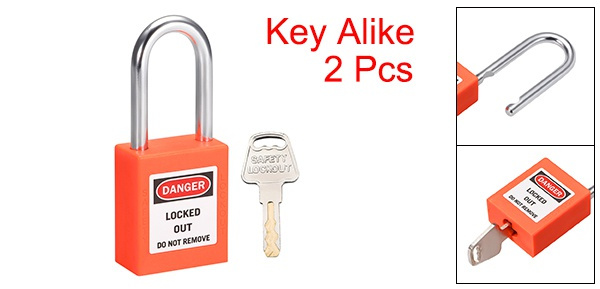
In high-motion industrial environments, split-second decisions determine safety outcomes. One of the most overlooked yet critical elements in a lockout/tagout (LOTO) program isn’t the procedure—it’s the lock. Specifically, lockout tagout locks keyed alike offer a simple but powerful solution to a common problem: too many keys, too much confusion, and too much risk.
When maintenance teams scramble during planned shutdowns or emergency repairs, fumbling through key rings or waiting for supervisors to unlock devices can delay workflows and compromise safety. Keyed alike lockout locks eliminate these inefficiencies by allowing multiple locks to be operated with a single key—without sacrificing control or compliance.
This isn’t about convenience. It’s about designing a safer, faster, and more coherent energy control process.
Why Standard Lockout Locks Fall Short
Traditional lockout programs often rely on individually keyed safety locks. Each employee has a unique lock with its own key. While this supports personal accountability, it creates logistical bottlenecks.
Imagine a three-person maintenance crew working on a conveyor system. Each technician applies their personal lock to isolation points—breakers, valves, motors. But when one team member leaves early or misplaces their key, the others are stuck. The machine can’t be re-energized until every lock is removed. Downtime escalates.
This scenario plays out daily in facilities where lock management wasn’t designed with operational flow in mind.
Even worse, some sites issue multiple locks to a single worker, each with different keys. The result? Keychains grow into tangled clusters, increasing the risk of lost keys, lockouts (ironically), or worse—unauthorized unlocking.
How Keyed Alike Lockout Locks Solve Real-World Problems
Keyed alike lockout locks are designed so that one key operates multiple locks. It’s a subtle shift with major operational implications.
For example, a maintenance supervisor might carry a single key that unlocks all the safety hasps and padlocks used during a scheduled line shutdown. Technicians still apply their personal locks—ensuring individual accountability—but the supervisor’s master key enables coordinated re-energization when work is complete.
This setup supports both safety and efficiency:
- Faster turnaround: No waiting for individuals to return or retrieve keys.
- Simplified key management: One key per team or shift, not one per lock.
- Reduced risk of lost keys: Fewer keys in circulation means fewer points of failure.
- Consistent compliance: Easier audits, fewer procedural deviations.
Crucially, keyed alike does not mean “shared control.” The individual lockout principle remains intact. Each employee still uses their own padlock with their name and contact info. The common key simply removes operational friction at the end of the process.
Common Misconceptions and Risks Despite their advantages, keyed alike systems are sometimes misunderstood.
Myth 1: “Keyed alike means anyone can unlock any lock.” No. A properly implemented keyed alike system still follows OSHA’s one-key-per-person rule for application. The common key is typically restricted to supervisors, shift leads, or lockout coordinators—not general staff. Access remains controlled.

Myth 2: “It violates LOTO standards.” Not if implemented correctly. OSHA 29 CFR 1910.147 does not prohibit keyed alike locks. It requires that each employee have exclusive control over their lock. As long as personal locks are used during isolation, and the common key is only used for administrative recovery (e.g., re-energization after clearance), compliance is maintained.
Myth 3: “It’s only for small teams.” Far from it. Large facilities use zone-based keyed alike systems—each production line or department has its own set of locks with a unique common key. This maintains control while scaling efficiency.
Practical Use Cases in Industry
Real-world applications reveal the flexibility of keyed alike LOTO locks.
Manufacturing Line Maintenance A bottling plant runs three shifts. Each shift team has five members. During changeovers, multiple isolation points need locking—motors, pumps, conveyors. Each technician applies their personal lock. But instead of five different keys needed to restart, the team lead carries one key that opens all five locks—because they’re keyed alike within the shift group. Changeover time drops from 45 to 22 minutes.
Emergency Recovery After Shift Handoff A night technician applies a lock during troubleshooting but leaves before completing repairs. The morning team verifies the lock is still in place, checks the tag, and follows procedures. But if the night tech forgot their key? With a keyed alike system, the supervisor uses a department master key to remove the lock—after confirming the work is done and the area is safe. No delay, no violation.
Contractor Access with Controlled Authority Contractors often lack access to site-specific keys. A facility issues contractor locks that are keyed alike but use a different key profile than employee locks. A site safety officer holds the key. Contractors apply locks, but only authorized staff can unlock—ensuring oversight without compromising workflow.
Choosing the Right Keyed Alike Locks: 5 Top Options
Not all safety locks are built the same. Below are five reliable, widely used lockout locks that offer keyed alike configurations:
| Product | Material | Shackle | Keyed Alike Sets | Special Features |
|---|---|---|---|---|
| Master Lock 1500KAL | Durable nylon | 1-1/2" steel | Up to 12 locks per set | Lightweight, vibration-resistant, ideal for electrical panels |
| Grace Industries GI-200KA | Reinforced polymer | 2" corrosion-resistant | Custom group sizes | High-visibility color options, UV stable |
| Spartan Lockout SL-KA-20 | Industrial-grade plastic | 2.5" stainless steel | 5–20 units per kit | Suitable for extreme temps (-40°F to 185°F) |
| Bulwark Safety BKA-LOCK3 | Flame-resistant composite | 3" brass shackle | Modular expansion | Used in oil & gas, meets NFPA 70E |
| Seton 72609-AL | Polycarbonate body | 1.75" hardened steel | Pre-numbered sets | Includes tags and audit-ready logs |
When selecting, consider: - Shackle length (must clear isolation points) - Material resistance (chemicals, heat, weather) - Color coding (red for electrical, yellow for mechanical, etc.) - Audit readiness (numbered locks, tag compatibility)
Implementation: Building a Keyed Alike System That Works
Rolling out keyed alike locks isn’t just about buying new hardware. It requires planning.
Step 1: Map Your Isolation Points Conduct a full audit of energy control points. How many locks are typically used per job? How many technicians are involved?
Step 2: Define Key Access Levels Who gets the common key? Supervisors? Safety officers? Use role-based access, not convenience-based.
Step 3: Group by Zone or Shift Avoid a single “site-wide” keyed alike set. That creates too much risk. Instead, group by department, line, or shift. This limits exposure and supports accountability.
Step 4: Train and Document Train all staff on the difference between personal locks and common-key operation. Update LOTO procedures and include diagrams showing who holds which key.
Step 5: Audit and Rotate Conduct quarterly audits. Check for lost locks, unauthorized key duplication, or misuse. Replace sets if compromised.
Limitations and When to Avoid Keyed Alike While powerful, keyed alike systems aren’t universal.
Avoid them when: - High security is required: In labs or controlled environments where access must be strictly limited. - Contractors work unsupervised: If third parties handle locks without oversight, individual keys reduce risk. - Regulatory restrictions apply: Some sites (e.g., nuclear or pharmaceutical) mandate unique keys per lock with no exceptions.
Also, never use keyed alike locks where the common key is widely distributed. The goal is operational efficiency—not creating a master key that undermines safety.
Final Insight: Simplicity as a Safety Feature
Most safety failures don’t stem from ignorance. They stem from complexity.
When a procedure is too hard to follow, people cut corners. When key management becomes a chore, locks get left on, tags go missing, or bypasses happen.
Keyed alike lockout locks reduce friction without weakening control. They align safety with workflow—not force safety to fight against it.
For facilities serious about compliance and uptime, the move to keyed alike isn’t a small upgrade. It’s a strategic shift toward smarter, human-centered safety design.
Start by evaluating your current lock inventory. Identify one high-frequency maintenance task where delays occur. Pilot a keyed alike set. Measure time saved, incidents avoided, and user feedback.
Then scale what works.
Frequently Asked Questions
Can OSHA approve the use of keyed alike lockout locks? Yes. OSHA does not prohibit keyed alike locks as long as each employee applies their own lock and retains control during the work period.
Does “keyed alike” mean all locks on site use the same key? No. Most facilities use segmented systems—by department, shift, or zone—to maintain control and limit risk.
Can I expand my keyed alike set later? Yes, most manufacturers offer expansion locks that match existing keyed alike groups.
What happens if the common key is lost? Treat it like a security breach. Remove all locks in the set, replace them, and reissue with a new key. Document the incident.
Are plastic lockout locks durable enough for industrial use? Yes, high-quality polymer locks (like nylon or polycarbonate) resist impact, chemicals, and UV exposure—often better than metal.
Do keyed alike locks cost more? They may have a slightly higher upfront cost, but they reduce downtime and administrative overhead, delivering strong ROI.
Can I color-code keyed alike sets? Absolutely. Use colors to distinguish departments, energy types, or shifts—red for electrical, blue for pneumatic, green for contractor use.
FAQ
What should you look for in Lockout Tagout Locks Keyed Alike: Safety Without Complexity? Focus on relevance, practical value, and how well the solution matches real user intent.
Is Lockout Tagout Locks Keyed Alike: Safety Without Complexity suitable for beginners? That depends on the workflow, but a clear step-by-step approach usually makes it easier to start.
How do you compare options around Lockout Tagout Locks Keyed Alike: Safety Without Complexity? Compare features, trust signals, limitations, pricing, and ease of implementation.
What mistakes should you avoid? Avoid generic choices, weak validation, and decisions based only on marketing claims.
What is the next best step? Shortlist the most relevant options, validate them quickly, and refine from real-world results.